
I see Art as a form of subjective and evocative human expression that has gone through a creative process before it is presentable to other humans.
Over the past couple of years, AI (generative AI) has been largely successful in assisting humans in artistic production of fiction, poetry, music, and digital imaging. The notion of AI generated music pieces is unsurprising. Mainstream design products such as Photoshop and Figma have long been integrated with AI.
Things are less boring in the motion pictures realm: From its creation back in 2025 to the recent announcement of its leading role in the movie Misaligned, Tilly Norwood, an AI actor, has drawn the attention of many. On a less conspicuous side, voice acting has been under a lot of turbulence as studios have shown a propensity towards using AI for dubbing and voice overs. On a different front, it’s not that long since Innovative Dreams has announced its role as a pioneer in Realtime Hybrid Filmmaking; a method that combines various filmmaking techniques using GenAI capabilities to increase film production productivity.
But what about other forms of art like dance, or theater? When I ask myself this question, I feel a sense of awkwardness, absurdity, and unease deep inside.
Take theater as an example; theater is a form of expression that involves many elements: light, decor, sound and music, and most importantly humans. But that is still no different from cinema. What makes theater distinct is the live experience aspect of it. The artistic expression is through a live human experience medium. It is a unique occurrence in space and time. Once done, it’s gone. One can still watch a recording of it, or watch the performance the following day in the same theater but that is a different experience; it is the same venue, but in a different time. The audience could still be very much the same (although very unlikely), but it is still a different experience. It is a direct human experience.
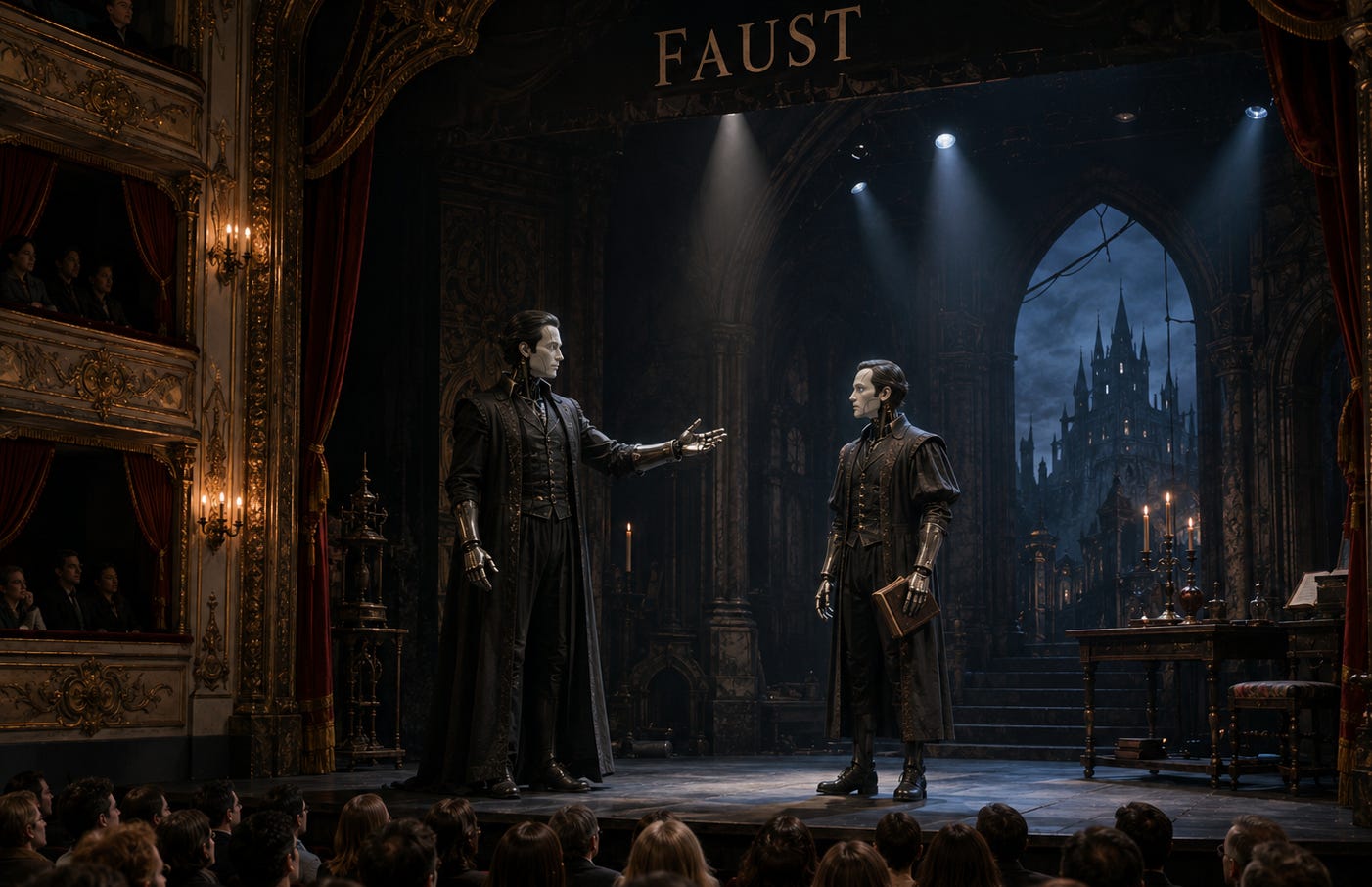
How can an experience like theater be influenced by AI? Maybe, in its elements; e.g., an AI generated playscript; or an AI generated lighting, audio, or scene plan. There is a considerable technological barrier to go beyond this point; to automate the execution of the experience; to replace some or all actors and actresses with humanoids; to automate the process of setting the scene, programming the humanoids and preparing the humanoids’ makeup, and costume, etc. This is why, without a multitude of breakthroughs, AI is unable to play the same role as in music or cinema.
But let’s take a step further; let’s assume we have the technological capacity today [1]. The question is, is an automated theater experience an art anymore?
In my view, at a certain point, when we remove humans from the performance altogether, we lose the art. This is because arts like theater are about co-presence with another human; with another consciousness; that the value is in a fellow human being there, becoming sad, ecstatic, or risking failure, in the same room. Music puts an instrument between the artist and the audience; in theater, the human is the instrument.
But isn’t cinema the same? In cinema, like theater, actors and actresses are artists too. They perform and their role play is their artistic expression. Even with that, cinema is still different: cinema is not live; although, assuming cinematic art production is automatable (assuming the costs are justified), humans will still be part of the production because they want to, as artists.
Back to theater, humanoids could hypothetically perform in such a way that we believe they are having a conscious experience. But should we make that choice? To me, it is less a choice than a condition of what we mean by art; a boundary we will want to stay within, and I believe we will. The reason is that humans want to express themselves in such a way: as dancers, opera performers, actors, etc. It is about humanity. I call this extent Limes Humanus (The Human Line).
Because of Limes Humanus, we will end up having humans in the loop; we may have some theater productions that have no humans in the mix and some that will. We will have robotic dance performances, and at the same time, we will have dance performances with humans in them.
If we want to pass the limit, something has to fundamentally change; either our collective understanding of culture and humanity, our society, or our very consciousness.
[1] I have intentionally left out the presence of artificial general intelligence (AGI) or super intelligence and the relevant alignment problem out; this is also the case for other discussion related to universal basic income (UBI) and wealth dissemination problem; main reason is to focus on the main concept.